|
29 Repeated Kan3 習坎
The lower: Kan (the abyss, water). The upper: Kan (the abyss, water). Repeated Kan: multiple peril, or learning from peril.
Hexagram
Preface: Things cannot always remain excessive (Guo); therefore Kan is granted. Kan is the abyss. Life is a course that varies with each phase; it will decline after having reached a peak. Da Guo (28) signifies that the masculine greatly exceeds the feminine in number, while Kan is the masculine being trapped by the feminine, as if plunged into an abyss. Kan (坎) in Chinese is composed of two characters, short of (欠) and the soil (土); thus Kan is an abysmal trap and stands for peril. Repeated Kan is constituted by two Kan trigram; therefore it is signified as multiple peril.
The reversal of hexagram Repeated Kan is itself, signifying that it is also perilous from the reverse view. The changing and following hexagram is Li (30), brightness and civilisation, which suggests that one should optimistically and faithfully undergo multiple peril. Its inner hexagram is Yi2 (27), to nourish, suggesting nourishing one's body in order to withstand multiple peril.
Text: 坎:習坎,有孚,維(maintain)心(heart)亨(progress smoothly),行(act)有(has)尚(advocate)。 Repeated Kan (multiple peril): Undergoing it requires possessing sincerity and trust, keeping the heart progressing smoothly, and acting according to what is advocated (or anticipated). Commentary on the text: Repeated Kan: it signifies multiple peril. Water flows continuously but won’t overflow; it travels in peril but won’t lose sincerity and trust. It ought to keep the heart progressing smoothly, and it can count on those of rigidity (i.e. lines 2 and 5) in the middle. It ought to act according to what is advocated (or anticipated), as there is merit obtainable in going forth. The peril of the heavens cannot be surmounted; the peril of the earth includes mountains, rivers and hills. The king and duke use perilous terrain to protect the country. In the time of Kan making appropriate use of Kan is momentous! Text explanation: Trigram Kan denotes water which flows downward. The water of the lower trigram flows downward, and the water of the upper trigram flows down to the lower; therefore it continues flowing without stopping. The flowing water will overflow if it is stopped and contained. The water of Repeated Kan won’t overflow signifying that it won't stop and change its nature (of flowing downward) in multiple peril, i.e. it acts continually and consistently. This is signified as sincerity and trust denoted by trigram Kan. Likewise, people should not change their virtue, values, principles, commitment, etc. when encountering peril. Lines 2 and 5 are both the rigid masculine at the axle centres. This signifies that they are firm and possess the principle of moderation, as well as being trustworthy and acting sincerely. Given that, there will be nothing to daunt them or make them hesitate in their heart. To act with a clear goal and according to a planned course, they can go forward and receive merit as the next hexagram, Li is brightness and civilisation. Peril in the heavens, such as wind, rain, thunder and lightning, vary capriciously and cannot be surmounted. Peril on earth, including mountains and rivers, are difficult to cross and provide a natural defence. The king and duke make use of perilous terrain to protect their land; it is meaningful when peril is used as a protective measure. Commentary on the image: Water is approaching without interruption: repeated Kan. A gentleman, in accordance with this, must act with his virtue as usual, and repeatedly review what is taught. Repeated Kan in Chinese, 習xi2 (to review what has been learned) 坎kan3, can be translated as 'learning from Kan’, i.e. to learn how to navigate the abyss without getting trapped, and to act in peril without getting hurt. Water like peril is approaching, recurrently. A gentleman should not be afraid and change his virtue, but repeatedly learn what has been experienced in times of peril. Overview: In multiple peril one must remain sincere and trustworthy (with respect to one’s virtue, values, principles, commitment, etc.). One must also keep the heart progressing smoothly (i.e. be faithful and optimistic, without being afraid of peril or affected by it). And one should behave firmly and moderately (i.e. neither aggressive nor yielding), as well as act according to one's goal. Repeated Kan only possesses the virtue of smooth progress, as it is required to leave multiple peril. One can reach civilisation and one’s future will become bright after successfully undergoing and learning from abysmal peril. The next hexagram Li (30), brightness and civilisation, is also the changing hexagram of Repeated Kan.
Lines
Deduction: Line 6 of hexagram 28 (Da Guo) walks through water and its head is submerged; (this is) an ominous omen, (but with) no calamity. Although it can be free from calamity, it is still trapped in the river after leaving hexagram Da Guo and arriving at Repeated Kan. In Repeated Kan, all lines are trapped in an abyss, or river, and must face peril. Line 1 lacks experience; therefore it is trapped while encountering peril. Lines 2 and 5 possess masculine strength and the principle of moderation; they are able to achieve something without aggression, and reduce the threat through an unyielding attitude. Line 3 must stop and remain alert when peril appears repeatedly. Line 4 approaches line 5 for assistance and succeeds in evading calamity. Line 6 doesn’t act according to experiences learned in peril; therefore it is put into a dark jail. However if it can see this as a lesson, it will see the sun at midday in the next hexagram Li (30), brightness.
The 1st line Text: 習坎。入(enter)于(into)坎窞(a pit in the ground),凶。 The subject is in a state of repeated Kan (multiple peril, or learning from Kan). It is falling into the pit of Kan (the abyss and peril); this is an ominous omen. Text explanation: Line 1 enters repeated peril and falls into the pit of an abyss. This is like a person becoming lost throughout the course of his life and arriving at a dangerous place and being plunged into peril; it is ominous. The gap in broken line 1 is referred to as the pit of the lower trigram Kan, an abysmal trap and peril. The text can be also interpreted as (the subject is in a state of) learning how to tackle Kan, (but) falling into the pit of Kan, (which is) an ominous omen. This is due to lacking experience with repeated Kan and failing to act according to its norm. Commentary on the image: Line 1 is in a state of repeated Kan (multiple peril, or learning from Kan) and falling into Kan; losing the course (or the norm) is ominous. Though line 6 of Da Guo survived, it failed to reach position 2 of Repeated Kan which possesses the norm of undergoing multiple peril; instead it falls into the pit of peril. Enlightenment through six one: 1) don't risk peril or 2) to restrain oneself. A person misses the right course and falls into the pit of abysmal peril; this is ominous. Or, he is unable to act according to the norm of Repeated Kan while learning how to tackle Kan, which plunges him into peril; this is ominous. The hexagram that appears when this line is activated changing to masculine is Jie (60), to restrict, where one learns how to live with external restriction from properly practiing self-restraint; this is possibly the advice.
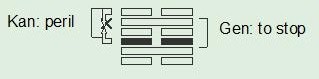
The 2nd line Text: 坎有(exist)險,求(seek)小(small)得(attainment)。 Kan (the abyss) exists with peril, suggesting seeking a small attainment. Text explanation: Line 2 reaches the middle of abysmal peril. It isn't afraid of peril because it possesses masculine rigidity (i.e. strength and firmness). It has an opportunity to leave as masculine tends to move; however it is still far from the end of the hexagram. It should not act aggressively but rather moderately, which suggests that it should only seek small achievements. Commentary on the image: Line 2 ought (or is able) to seek a small attainment; this is due to not departing from the middle (of peril yet, or the principle of moderation). Even though it represents the inner lower trigram Zhen (to move), there is another peril in front and the inner upper trigram Gen (keeping still) signifies stop; thus it is only permitted to act in a moderate way.
Enlightenment through nine two: to secure safety and then engage in small achievements. Though one possesses strength and firmness, one should act moderately and only seek small achievements as the environment still is perilous. After this line is activated, 1) the bottom trigram Kan disappears, and 2) the hexagram appears as Bi3 (8), wherein it builds an intimate and interdependent relationship with line 5 and gains mutual assistance.
The 3rd line Text: 來之坎坎。險(peril)且(for the time being)枕(pillow on it),入于坎窞。勿(not)用(act)。 The subject is in a state of coming and going between Kan and Kan (abysmal peril). It is in peril but tentatively taking a rest; it ought to avoid falling into the pit of Kan (the abyss). Do not act. Text explanation: One is in peril and has no way out. It is better to remain still and alert; otherwise one will be plunged further into peril. Feminine line 3 is at the position to leave the lower trigram Kan and move to the upper trigram. However the upper trigram in front is Kan as well. Therefore it moves back and forth between these two. Since the inner upper trigram Gen (keeping still, the mountain) signifies stopping and feminine tends to remain still, it should rest. If it doesn't, and keeps trying, it will fall into the pit of the upper trigram Kan. Commentary on the image: Line 3 is in a state of coming and going between Kan and Kan (abysmal peril). No merit is achievable in the end. There is no access to position 6 where it could leave Repeated Kan; rather there is the possibility of falling into the pit of the upper trigram at position 4, like position 1 of the lower trigram. Therefore it should not attempt it.
Enlightenment through six three: to secure safety and wait for the right time. Peril lies in front and behind; one is in peril and faces a dilemma. Even though one struggles back and forth, there is no way to get out. So it is better to rest and remain alert. No matter what is done, nothing is achievable and one will be plunged further into peril. If this line ignores the warning and changes to active masculine, it would reach line 6 through correlation but actually falls into the pit, as the earthen bucket breaks before reaching the top of the well when the hexagram appears as Jing (48).
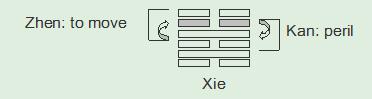
The 4th line Text: 樽(jug)酒(wine)簋(container for grains),貳用(use)缶(earthenware crock with a narrow opening)。納約自牖,終(eventually)无(no)咎。 One jug of wine and two bowls of grain, their value is added (貳) by using the earthen utensil to contain them. The subject ought to offer them together with a pact simply and clearly through the window built for ambient lighting (納約自牖). Eventually there will be no calamity (or fault). Text explanation: One jug of wine with two bowls of grain, both contained in earthen utensils, is a simple gift. In the time of multiple peril it is difficult to prepare lavish and appealing gifts. Therefore a gift must be presented in a notable way, through the right channels to the right person. This signifies that at the moment of crisis approaching someone for assistance must be done simply, clearly, and effectively. 約yue of 納 na4 (to offer in a submissive manner) 約自 zi4 (from) 牖you3 can mean both a pact and simplicity (i.e. a straightforward pact like a simple gift). 牖 is a window in ancient houses used for ambient lighting; it is the brightest place in a room where things are seen clearly. Though line 4 has left the lower trigram Kan, it is still in the peril of the upper trigram. However it is in the position of sustaining line 5, the masculine axle centre. Therefore it submits its request with a simple gift to ask line 5 for assistance. After it successfully approaches line 5, the upper trigram Kan disappears and changes to Zhen (to move). Then it is driven by Zhen and moves away from peril with the hexagram changing to Xie (40), alleviation of the crisis.
The upper trigram Kan, water, is taken here for wine, and the shape from line 2 to 5 is similar to hexagram Yi (27), nourishment, i.e. food. The inner lower trigram Zhen is a ritual utensil. Trigram Zhen, the reversal of trigram of Gen (the mountain, the hand), also resembles a hand turning up and moves (wine and food) upward. The hand of the inner upper trigram Gen receives (them).
The inner upper trigram Gen denotes a door and here is taken for a window. After lines 4 and 5 exchange positions, the inner lower trigram appears in the form of Li (clinging, fire), brightness, signifying that the action of presenting a gift is clearly expressed.
Commentary on the image: By means of offering one jug of wine and two (貳) bowls of grain, line 4 breaks the boundary between those of rigidity and tenderness. By presenting the simple gift, line 4 breaks the boundary between masculine line 5 and feminine line 4 and wins line 5's assistance creating an opportunity to leave peril. According to the punctuation given on the original texts, 貳er2 is signified differently as to benefit (or increase) and two. Hexagram Xie (40), alleviation of the crisis, will result if both lines 4 and 5 are activated and change together; this signifies that they must cooperate to solve the crisis. Enlightenment through six four: to act in a sincere and effective way to obtain an alliance for leaving peril. One jug of wine and two bowls of grain are both contained in earthen utensils and presented clearly with one's request to the right person. This signifies simplicity and sincerity, as well as the correct action at the right time. As a result, those above and below will work together, and one is rescued from the possible calamity generated by peril. Should this line change to masculine and not act with the right approach, the hexagram would become Kun4 (47), to be besieged.
The 5th line Text: 坎不(not)盈(have a surplus of, brim),祗既平,无咎。 Kan (abysmal peril or water) does not exceed the brim, and land emerges with its flat top (祇既平); this is of no calamity (or fault). Text explanation: The water of the abyss is ebbing; thus the sandbank emerges with its flat top. As the sandbank is exposed, there is no imminent peril. 祇gi2 of 祇既ji4 (already) 平ping2 (flat) is the deity of earth, which here is signified as land. The inner upper trigram Gen denotes the mountain and line 5 looks like a sandbank emerging from the river.
Even though line 5 is masculine strength and on the sandbank, it is still in peril as the sandbank might be deluged and becomes a hidden reef. Therefore it must still exert itself unyieldingly to turn peril into safety; then it can be completely free from calamity. Commentary on the image: Kan (abysmal peril or water) does not exceed the brim, yet the middle isn't large enough. Due to the principle of moderation available at position 5, the water of the abyss won’t exceed the brim. However, the sandbank only emerges with its flat top, signifying that the masculine strength of line 5 isn't large enough and the threat of peril still exists; therefore it must enhance itself (i.e. its masculinity) in order to enlarge the sandbank. Enlightenment through nine five: to keep on doing what is right with a joint force. When this line is triggered to move, it signifies that the sand-bank emerges, and peril isn't imminent. However the sandbank is not large enough, and one should seek greater results in order to secure complete freedom from peril. If this line acts accordingly and transforms to feminine at last, the upper trigram will become Kun1 (earth), and the hexagram will appear as Shi (7), troops, where people with the same goal group to defend themselves.
The 6th line Text: 係(tie)用(by means of)徽(cord)纆(rope),寘(put)于(in)叢棘(throne bushes)。三歲(there years)不(not)得(attain, obtain),凶。 The subject is in a state of being fastened by cords and ropes, and placed in thorn bushes. Within three years release is not possible to attain, which is an ominous omen. Text explanation: Thorn bushes here refer to what is planted along the walls of prisons to prevent escape. A person is restrained and put in jail for over three years, signifying that he is a felon and won’t be released for a long time. Trigram Kan represents the law as water can be used as a tool to check levels. The inner upper trigram Gen looks like a door and here stands for a house. Trigram Kan also denotes a rigid tree covered in thorns which is taken for thorn bushes. Combined, these images suggest a prison.
Line 6 reaches the end of hexagram Repeated Kan. Supposedly peril is about to end, resulting in safety. However, peril becomes even more serious and time seems at a standstill, like being put in jail. This is because line 6 doesn’t act according to what was taught along the course. Commentary on the image: Line 6 loses the norm (or, gets lost on the course), thus the situation will remain ominous for three years. Feminine line 6 rides on masculine line 5, signifying that it intimidates line 5. Therefore the norm represented by line 5, the host line of the hexagram that diminishes multiple peril, is humiliated. Since it doesn’t act according to what was taught, it becomes lost in peril and put in a dark jail. This will last until it completes three steps (i.e. three years) and reaches position 2 of the next hexagram, Li (30). There the sun at midday is seen after it pays for its missteps. Enlightenment through six six: 1) to learn from experience and avoid the same faults, or 2) to get out of, and depart, as well as remain far from peril. Once again, one gets lost on the journey and can’t leave peril. This is like a repeat offender being restrained and put in jail; it is ominous. The hexagram forms after this line changes is Huan (59), where the wind disperses the water of the lower trigram Kan. This signifies that one can realign with the correct trend and find a way to reach the next hexagram Li, brightness. But this is only possible if one can learn from the experiences of Repeated Kan and behave like line 6 of hexagram Huan.
|

 Trigram
Kan is one masculine line seated between two feminine lines,
signifying that masculine is trapped by feminine and in peril.
One solid line moving between two broken lines also indicates a
river streaming over rapids; therefore the image of trigram Kan is
water (
Trigram
Kan is one masculine line seated between two feminine lines,
signifying that masculine is trapped by feminine and in peril.
One solid line moving between two broken lines also indicates a
river streaming over rapids; therefore the image of trigram Kan is
water ( ,
,